

HouseSit Match | nine-month PR engagement
Eight historical travel, house-sitting and real-life press records
HouseSit Match's historical media record demonstrates how a service platform can generate attention through useful guidance and the real experiences of people using its category of service. Eight archived entries concern lower-cost travel, house-sitting experiences in Britain and abroad, luggage advice, environmental questions and the rules that travellers may encounter when arranging a stay overseas. The source list includes the Daily Mirror, The Sun, Daily Express, Chat and Fodor's Travel.
The account owner confirms a nine-month PR engagement. The archive is dated 22 July 2022 to 1 May 2023, a period somewhat longer than nine calendar months. Exact contractual dates were not supplied, so this case study describes the confirmed term separately from the full historical press record rather than implying that all eight appearances took place inside precisely nine contract months.
Seven records have publisher article URLs and original press-image links. The eighth is a Chat record with an original Image 1 but no publisher URL or complete headline. There are five outlet brands overall, because The Sun and The Sun Online refer to the same title and three of the entries were published there. The different formats matter to a factual case study.
The platform and why journalists were interested
HouseSit Match is a house-sitting and pet-sitting network connecting homeowners who need someone to look after their property or pets with sitters seeking arrangements, often in exchange for accommodation rather than wages. It was founded by Lamia Walker, who is named in the platform's own public information as its founder. The company describes its service as a way to build trust between homeowners and people who enjoy caring for pets and travelling.
The editorial possibilities extend beyond company announcements. Travel reporters may be interested in how people reduce accommodation costs, how pets can stay in familiar surroundings while owners are away, or what practical planning and trust measures an exchange requires. Money journalists may find case studies involving individuals who live differently or take extended trips on limited budgets. Readers can relate to these problems without necessarily knowing the platform already.
There are important limits. House-sitting is not the same as getting a trip without any costs or responsibilities. Travel, insurance, visa permissions, pet welfare, personal safety and the commitments agreed with the homeowner all matter. Responsible coverage should make those distinctions rather than presenting every arrangement as universally accessible or risk-free.
1. House-sitting as one option in a more conscious approach to travel
The Daily Mirror recorded a July 2022 article about reducing the environmental impact of travel. House-sitting was discussed alongside other ideas, including virtual experiences and being more thoughtful about flying. This is a broader travel and sustainability story rather than an advertisement for a particular booking website.
It illustrates a plausible editorial route for the founder of a house-sitting network: explain what an exchange involves and what its practical considerations are when travellers are reviewing their choices. The source archive associates the story with HouseSit Match, but the original article or saved press image should confirm exactly who was quoted and which claim was attributed before the case study reports it as a verified founder interview.
Nor would that article prove that every house-sit has a smaller environmental footprint. The actual effect depends on how far someone travels, what transport they use and what would have happened otherwise. The case records a published discussion, not an independent carbon assessment of individual trips.
2. Real people, unusual homes and the travel press
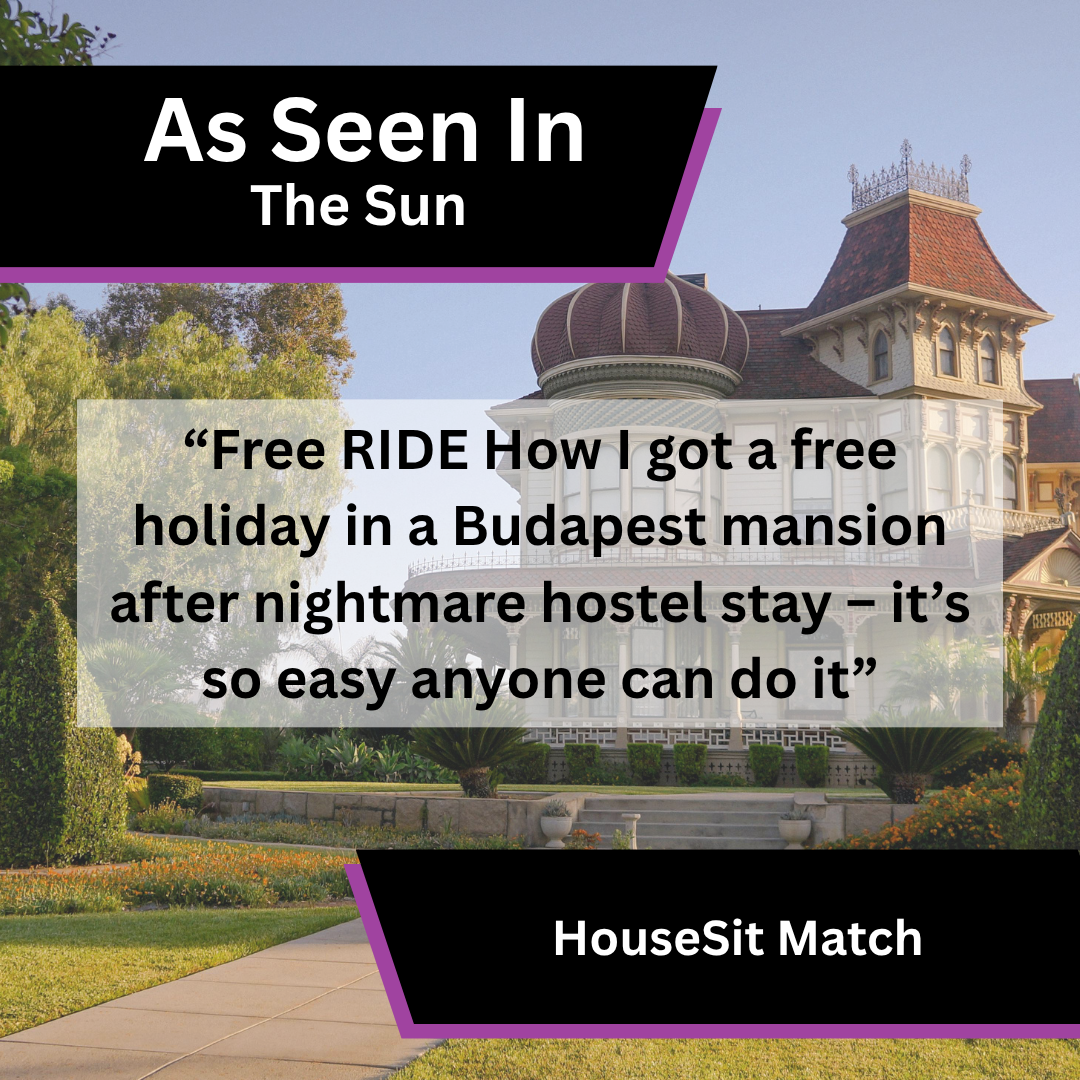
The Sun's December 2022 article tells the story of a traveller who spent time in a Budapest mansion after an unpleasant hostel experience. The board labels this as Ellen's case study. The unusual contrast between the two accommodation experiences offered a strong human-interest hook. A reader can understand why an unconventional way of staying somewhere might be newsworthy even if they have never used a house-sitting service.
The later January article describes a person who travelled internationally using house-sitting arrangements for many years; the original archive calls this Keith's case study. A third Sun article, dated February 2023, focuses on a person living without paying ordinary rent in a large Surrey property, labelled Alex's case study internally. They are three separate publisher URLs and three different claimed personal stories, all connected with the broad possibility of accommodation in exchange for looking after a home.
A responsible PR case study must verify the actual named people, their permission to share the account and how the publication connected them to HouseSit Match. It should not turn a headline about 'free' travel into a guarantee that accommodation, transport, visas, pet care or other expenses will cost nothing. Nor should a story about one house-sitting arrangement be used to suggest that readers can automatically find a similar one.
3. Providing useful travel advice beyond house-sitting itself
Two Daily Express articles from December 2022 discuss travel preparation. One considers the choice of luggage tags and the possibility of lost bags; another describes a travel expert's unusual packing precaution. Both are related to everyday concerns of people taking a trip, but neither is simply a feature on a house-sitting website.
A founder or regular participant in travel arrangements may have first-hand experience of common mishaps and preparation decisions. That can be relevant to a journalist collecting practical tips. However, the exact person and contribution must be checked against the original press screenshots rather than automatically assigning the comments to founder Lamia Walker. An unusual packing idea is not necessarily recommended by all travel experts, and it is not official transport security advice.
These articles illustrate a broader benefit of knowing a sector well. A business owner who has real experience of customer travel questions may help a reporter explain a specific issue. The contribution can be relatively small and still fit the editorial question, without the article becoming a full profile of the company.
4. A print-style human-interest record that needs careful proof
The archive contains an April 2023 Chat magazine record labelled Kelly's story. It has an original press-proof image but no publisher article URL and no complete article headline. Its existing Fair PR media-coverage reference uses a slug containing a different person's name, which does not agree with the 'Kelly' label. That conflict needs to be reconciled with the actual original print page before any particular person or their experience is attributed in a public case study.
Print coverage can be legitimate evidence even when there is no online link. The correct approach is to preserve the source image, establish its title, date, published page, people featured and connection with HouseSit Match, and obtain any necessary consent. We should then include it as an archived print entry with an accurate caption, not an invented clickable article URL.
A personal story may reveal private details about where someone stayed, how they managed money or what happened to them. Those details require an especially proportionate approach to reuse, even if the original publication was public. The case's general description can remain restrained until the actual page is checked.
5. Legal and practical questions about international stays
Fodor's Travel ran a May 2023 article examining whether people can legally house-sit or pet-sit abroad in exchange for accommodation when they enter on a tourist visa. Its subject illustrates a real challenge that promotional travel stories can overlook. A seemingly informal unpaid arrangement may still be treated as work or a service for immigration purposes, depending on the jurisdiction and the facts.
HouseSit Match is associated with the article in the source archive, and the original press image must establish its precise role. The article also discusses legal perspectives and official immigration implications, so it would be misleading to present a house-sitting-platform founder as the source of binding immigration advice. Any legal comments should be attributed to the qualified people actually quoted.
The original article is a historical record from 2023. Visa and border-enforcement rules may change, and a reader should seek current official guidance for the place they intend to enter. The coverage's relevance to the client is that the topic affects how potential users understand the service, not that the article confers legal approval on every international arrangement.
What this historical PR record supports
The nine-month PR engagement length was confirmed by the account owner. The entire archived publication window extends from July 2022 to May 2023. Nothing in the source establishes exact contractual start and end dates, live audience reach, platform registrations, sitter bookings, new homeowner sign-ups, revenue gains or current backlinks attributable to the coverage. We therefore make none of those claims.
The most useful result is the variety of genuinely interesting editorial subjects around a service that might otherwise appear niche: alternative accommodation, real travellers' experiences, common travel questions and the legal boundaries of a global service. The sources can illustrate those opportunities when attribution and individual consent are verified.
Published media coverage
| Publication | Archived date | Article or feature |
|---|---|---|
| Daily Mirror | 2022-07-22 | Housesitting and other ways to travel with a smaller environmental footprint |
| The Sun | 2022-12-04 | A traveller describes house-sitting in a Budapest mansion |
| Daily Express | 2022-12-05 | Luggage-tag choices to reduce the risk of bags going missing |
| Daily Express | 2022-12-12 | A travel expert's unusual packing precaution |
| The Sun | 2023-01-26 | House-sitting traveller describes years of low-cost trips around the world |
| The Sun | 2023-02-02 | Resident describes living without rent by house-sitting in Surrey |
| Chat | 2023-04-19 | Kelly's house-sitting story (original print source) (original print proof; no verified article URL) |
| Fodor's Travel | 2023-05-01 | Legal issues with international house-sitting or pet-sitting on visitor visas |
Images from the coverage



Campaign details
| Result | Details |
|---|---|
| Client | HouseSit Match, home-sitting and pet-sitting network |
| Founder | Lamia Walker, independently supported by HouseSit Match's public information |
| Confirmed PR engagement | Nine months; exact start/end dates not recorded |
| Archived media entries | Eight, including seven online URLs and one unlinked Chat print source |
| Publisher brands | Five: Daily Mirror, The Sun, Daily Express, Chat and Fodor's Travel |
| Date range | 22 July 2022 to 1 May 2023 (wider than nine months) |
| Specific source uncertainty | Chat Kelly story has inconsistent person label in original internal archive; exact person and permission need proof |
| No quantified outcomes | No verified new bookings, customers, registrations, search traffic, legal approval or backlink totals |
Frequently asked questions
How long was HouseSit Match's PR engagement?
Nine months, as confirmed by the account owner. The archive contains source dates from July 2022 to May 2023; these are kept separate from exact contractual dates, which are not recorded.
How many publications featured in the historical press list?
Eight source records across five media brands, including seven online article URLs and one unlinked Chat magazine record.
Is house-sitting abroad automatically permitted on a tourist visa?
No. Immigration treatment depends on current local law and the details of an arrangement. A 2023 editorial feature is not personalised or up-to-date immigration advice.
Did the campaign prove extra platform registrations or house-sitting bookings?
No. The archive demonstrates historical journalism associated with the client, not measured booking, registration, revenue or conversion outcomes.
Explore travel, accommodation and founder PR
A service platform with real customer experiences can often provide useful material for travel journalists. The essential work is verifying the stories, securing permission, matching each angle to the correct audience and accurately explaining any restrictions. Learn about Fair PR's Travel PR, Accommodation PR and Expert PR. To discuss a suitable campaign, contact us at Contact Fair PR.
